
Imagine it’s 10:15 on a Monday morning.
You’re already speaking to a customer when another person calls. Then, thirty seconds later, someone else rings.
One caller wants to book a job. Another is an existing customer trying to change an appointment. The third has a quick question before deciding whether to use your company.
Three completely normal calls.
The problem is, your team can only deal with so much at once.
One person gets answered. The others wait, reach voicemail, or hang up and try somebody else.
And this highlights something businesses often overlook when thinking about their phones:
The problem isn’t always how many calls you receive. It’s when they arrive.
Five calls a day can still cause a problem
A small business might look at its call history and think:
“We only get five or ten calls a day. We don’t need anything complicated.”
But calls rarely arrive neatly spaced throughout the working day.
They bunch together.
A plumbing company might suddenly receive several enquiries after heavy rain. A clinic can get a rush of calls first thing in the morning. A letting agent might have multiple tenants calling after an issue at a property. A professional services firm may get most of its enquiries during the same few hours.
Your average number of calls doesn’t tell the full story.
If three people call while you’re already speaking to somebody, you suddenly have a capacity problem, even if the phone was completely quiet for the previous hour.
What happens to caller number two?
Usually one of a few things.
They wait.
They reach voicemail.
They leave a message that somebody has to deal with later.
Or they hang up.
And that last option matters.
A new customer who is ready to buy doesn’t necessarily have any loyalty to your business yet. They searched for a service, found several companies and started calling.
If the first company doesn’t answer, trying the second one takes seconds.
The business hasn’t necessarily lost that customer because its service was poor, its prices were too high or its reviews weren’t good enough.
It simply wasn’t available at the moment the customer wanted it.
Hiring another person doesn’t completely solve it
The obvious answer is more staff.
And for some businesses, that absolutely makes sense.
But adding another receptionist doesn’t remove the underlying limitation. It simply increases the number of calls you can deal with before the same problem returns.
Two receptionists can handle two conversations.
What happens when four customers call?
You also have quieter periods where those additional staff still need to be paid, holidays to cover, lunch breaks, sickness, evenings and weekends.
This is where an AI receptionist works differently.
It doesn’t need customers to form an orderly queue.
One caller or twenty callers, each gets their own conversation
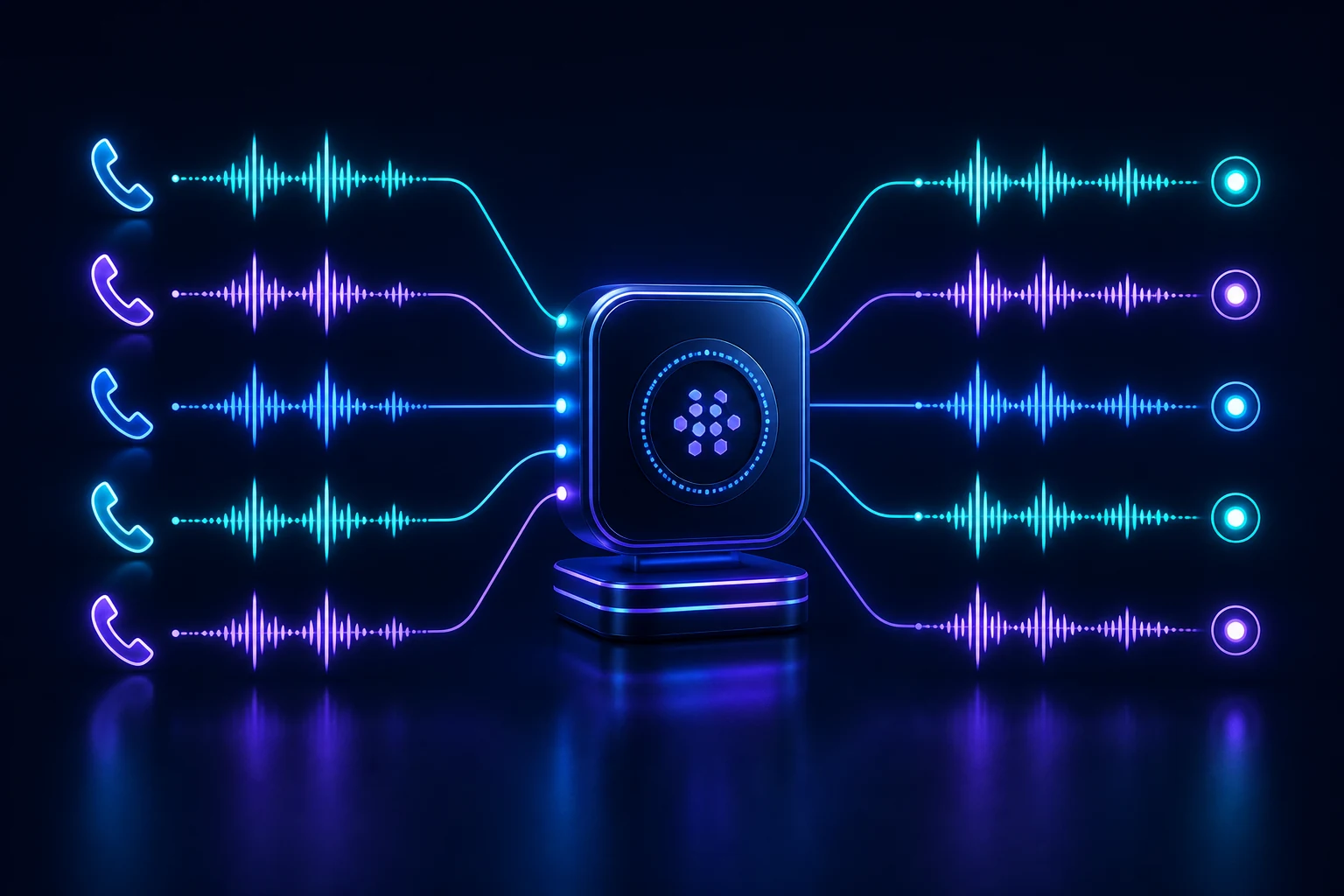
A Voice AI receptionist can handle multiple conversations simultaneously.
At SmartVoiceHub, Sally can handle up to 20 calls at the same time.
That doesn’t mean twenty people listening to the same automated message.
Each caller has their own individual conversation.
One person can be giving their details for a new enquiry while another is asking a question and somebody else is leaving information for an existing job.
To every caller, it simply feels like the business answered the phone.
That difference is important.
Because from the customer’s perspective, they don’t care that four other people happened to ring at exactly the same time.
They only care about their call.
And answering is only the beginning
Handling simultaneous calls wouldn’t be particularly useful if all the AI could do was say:
“Thanks for calling. Somebody will get back to you.”
A properly configured AI receptionist can actually deal with the reason for the call.
Depending on how your agent is set up, it can:
- Capture the caller’s name and contact information.
- Understand what they need.
- Ask the appropriate follow-up questions.
- Filter irrelevant or unwanted enquiries.
- Answer common questions using information about your business.
- Take messages for specific members of the team.
- Book or manage appointments.
- Update your CRM or other systems.
- Transfer calls when human involvement is required.
So instead of finishing a busy period with six missed calls and trying to work out who needs calling back first, you can finish it with six properly captured conversations.
Peak capacity without paying for peak staffing
This is one of the biggest differences between traditional reception and Voice AI.
With people, you generally have to staff for capacity.
If your busiest period needs three people answering phones but most of the day only needs one, you either carry that additional staffing cost or accept that some callers will have to wait.
AI gives businesses another option.
Your normal team can concentrate on the work that actually requires them, while the AI absorbs fluctuations in call volume automatically.
Quiet day? It answers the few calls that arrive.
Sudden rush? It handles those too.
After 5pm? Still answering.
Saturday morning? Still answering.
The capacity is there when you need it rather than only when somebody happens to be free.
It’s not about replacing every human conversation
There will always be calls where a person is the right answer.
A complicated complaint. An unusual situation. A valuable customer who specifically wants to speak with somebody. A conversation where judgement is required.
A good AI receptionist shouldn’t prevent those conversations.
It should make sure your team spends its time on them.
Routine enquiries, information gathering, appointment requests and basic questions don’t necessarily need to compete for the same person’s attention.
Let the AI deal with what it can. Let your people deal with what actually needs a person.
Your callers shouldn’t have to know you’re busy
Customers see your website, your reviews and your company.
They don’t see that one member of staff is on lunch, somebody else is driving between jobs and three customers have all decided to ring within the same two minutes.
And realistically, they shouldn’t need to.
Your availability should adapt to your customers, not the other way around.
That is where Voice AI becomes much more than another way of answering the telephone.
It gives a small or growing business something that traditionally required a much larger team:
the ability to be available whenever the customer decides to call.
And sometimes, that second caller is the one who was about to become your next customer.